Friday, August 16, 2013

Second Life- on escapism

The whole point of gaming, it can be said, is escapism. To escape from this world, to be so immersed in an experience that you forget everything else about you, even if for a short while. When you're playing a game, you're not you anymore. You are a witness to an epic adventure when you play an RPG, a powerful electronic athlete when you play a MOBA, or a romantic hero when you play a dating sim. But there is a game that takes this notion and runs with it entirely, turning it into its Modus Operandi. That game is Second Life.


Second Life is a free to play three dimensional game. Some may claim it is not a game, as there are no goals or anything of the sort, but I disagree. However, I am not here to debate whether Second Life is a game or not. I am here to speak about how Second Life brings escapism to a whole new level.

The very name in itself gives away the purpose of the game. Second Life: a second life for you, the player. Here is a game world unlike any other. Here is a world for you to create, to be free. To buy what you like, to be who you want to be. You are limited only by your imagination.


And yet, therein lays a question. Is this right? Is it right to escape from your real life to pretend to be someone you are not?

In Second Life it is easy to be someone you're not. No, let me rephrase that. It is easy to pretend to be someone you're not. In Second Life, you can start your own business. You can dress your avatar down in the latest Gucci suit, give him sunglasses, a chauffer, the works. You can rent out a house made to look like a mansion, in a sim that closely resembles West Hollywood. You can have an office, you can sit your avatar down in meetings. You can be this huge success, and honestly? That does not sound so bad. But, when you turn off that computer, where will you be? Back in real life. Hopefully with a family that loves you, working a job that pays the bills, on a nice enough house that may not be a mansion, but it provides what you need. I wish to God this was how it always is. And for most people, it is. But not everyone is like this.

Too many people take the game more seriously than they should. Single people go on here looking to start relationships. Sometimes they find it, and their avatars enter a pretend relationship, where they go on pretend dates to places that are simply not real. I have seen avatars go to sims made to look like amusement parks. It may be fun to pretend you are on a date, but you're not. You're not in a real amusement park, you're at home, on a computer, watching two avatars go up and down a fake roller coaster. Too many people forget this.

Far too many avatars are done up to look like glamour models. I understand that, sometimes, we are unsatisfied with how we look. We often wish to ourselves "if only I were skinnier", "if only I were more tanned", "if only I were white, blonde, blue eyed, slim and petite." Second Life does not give you the chance to live that life, no matter how much we wish to pretend we were. Second Life only allows you to make an avatar that looks like what you wish you it to look like. By itself, that's not bad, but some people take it too far. I once had the misfortune of knowing someone who ditched a friend, just so she could date someone who's avatar looked like her favorite rock star. The guy behind the avatar was married in real life, but the two began an online relationship anyway.

That's another issue. People catfishing, pretending to be someone online when in real life they are someone else, beginning online relationships on false pretenses. I have seen this happen far too many times. I once met two people on Second Life. A boy and a girl. They were in a relationship. They were in love. Thing is, the guy was really a girl in real life, and the girl was perfectly straight. The 'guy' eventually confessed, and they broke up afterwards. No harm was meant, but the 'relationship' was simply false to begin with.

That's why I don't believe in relationships that start on Second Life, or anything from Second Life at all. There is always a falseness to it, to everything. What you are seeing may look like something, but it is not. It is simply a bunch of 1's and 0's, gathered together to create data to look like an object from real life. It is not real.

It is not real. That tiny phrase, to me at least, became almost like a mantra that I repeated to myself every time I logged in to Second Life. It is not real. It is not real. It is not real. So why treat it like it is? Why treat something fake like it's real?

Sometimes, real life becomes too much to bear.We often fail, we often grow tired. We often just feel like retreating, to get away from the hustle and bustle. Video games offer us a retreat from this. In a video game, we can rescue the princess, we can develop a farm, we can save the world from the Magic Emperor, we can date a high school girl. But this retreat is not meant to replace your real life. After you're done, you're supposed to be re energized, so you can take on the world. But when you start neglecting your real life, for a game? That's when you have a problem.

Escapism is not the answer to anything. Running away from your problems does not solve them. It is OK to take a rest. It is not OK to abandon yourself in a game. You don't need a Second Life, if your First Life is not what you wanted it to be. You just need to get out there and make it happen.

Wednesday, August 14, 2013

The Disgaea metaphor

Every now and then you come across a game that hides a deep, meaningful message beneath layers of a gaming element that would make it easy for someone who looks only at a surface level to miss it. Today, I want to briefly talk about a game that talks about what it means to be a good person. That game is Disgaea.


The game is, on the surface, about this guy, called Laharl. He's a demon, and he's 1313 years old. His father, King Krichevskoy, has died, leaving Laharl to assume the position of Overlord. Laharl himself is, in one word, an ass. He's arrogant, he's rude, he's loud, he's obnoxious, and he has the emotional maturity of an 11 year old boy.

Pictured: Laharl. You just know that, if the artist were allowed to draw him that way, this kid would be flipping you the bird.

 In Disgaea, the world is divided into three parts: There's the human world, the world of demons named the Netherworld, and the world of angels named Celestia. Laharl was the prince of the Netherworld, and spends the first half of the game becoming its ruler. However, there is a complication: the ruler of the angels, the Seraph, has sent an assassin to do away with Laharl. And her name is Flonne.
Not Pictured: A competent assassin.

Flonne, however, eventually learns that Laharl is incapable of love and compassion. Feeling that such a thing is impossible, she joins Laharl, to observe if he truly is incapable of such things. Because of her continuous belief in love, Laharl and his vassal, Etna, give the little angel the title of Love Freak. 

In spite of the abuse that Laharl and Etna send her way, Flonne stays, determined to see if Laharl truly is incapable of love. When she loses her special angel pendant, which allows her to stay in the Netherworld, she begs Laharl to help her. He does, though only through the promise of a reward.

Flonne is someone who believes in love and kindness. She believes everyone is capable of good, and that no one is truly irredeemably evil. Throughout the game, her faith is rewarded: She sees demons, whom she had been taught knew nothing of mercy or love, commit acts that could only be fueled by such emotions. She sees Laharl spare a demon's life, because the demon had a son who begged for his father to be spared. She witnesses Laharl cry for his departed mother. She sees Laharl put his subjects before himself, albeit slightly begrudgingly, when he rounded up the zombies that were collected by a child of his realm, which had managed to escape. Flonne, in time, learns that in spite of how he's a demon, Laharl is, deep down, good. In fact, no. Flonne learns that someone being a demon, a human, or an angel is not what determines if they are good. All are capable of love.

And in time, she learns the true nature of her mission: She was to become the bridge between the Netherworld and Celestia, to bring peace between these once bitter enemies. But, there are those in Celestia who would oppose such a thing.


                           Pictured: Vulcanus. An Angel of God, and an asshole.


Vulcanus, who does not know of the Seraph's true plan, and would oppose it if he did, sets out to murder Laharl himself. Unlike Laharl, Vulcanus is truly evil. Among his plans, he manipulates the human world into attacking the Netherworld, costing an untold amount of casualties, just to kill Laharl. He is the one who stole Flonne's pendant, endangering her life, just to be rid of her. And the worst of all, he makes pacts with several demons, forbidden by angel law, just to destroy Laharl.

Vulcanus reminds me too much of people that claim themselves to be good by virtue of being religious. There are a lot of people in this world, none of whom I will name, that believe themselves to be paragons of virtue just because they read this holy text, or they pray at that church. In fact, that's who Vulcanus is: he's every religious hypocrite in the world, rolled up into an arrangement of two dimensional sprites. He's everyone who has ever held up their nose to the poor as they strutted down to church. He's every church goes who has ever gone to a diner and left no tip to the waiter. He's every pastor, every priest that has ever preached the word of God only to throw out someone from his parish by virtue of not wearing decent clothing. He's every deacon that has ever preached against homosexuality, only to go to Vegas to buy a male hooker. He's every Rabbi that has eaten pork, every Imam that has ever spat at a beggar.

Flonne, on the other hand, is like every authentically religious person in the world. She practices what she preaches, and she is not afraid of standing firm in her beliefs. But, she does not rub it in the faces of those who are different from her. Flonne believes in love, and that is what she shows the world. She shows everyone love, patience, and understanding. She stands by Laharl and Etna through thick and thin, expecting nothing in return every time she helps them. The one time Flonne stands up to Laharl is when she demands that he treat her with respect, to at least remember her name, which in time, he does.

Laharl himself is an impetuous being, but deep down, there is good. He thought himself incapable of love, but deep down, he loved his mother. Deep down, Laharl cares about more than himself. He cares about his Netherworld, about his vassals, about Etna, and Flonne.

That's what the game is about, when you get down to it. The game asks "what makes a person good?" And the game provides an unambiguous answer. The game sides with Flonne, 100%. Love is what makes someone good. Nothing else. Vulcanus himself, who is more than worthy of punishment, is shown mercy by Flonne herself, when she, at the end of the game, becomes his teacher.

What makes someone good? It's how you treat everyone else. It's not what you associate yourself with, it's how you treat other people. Being part of a religion does not make you a good person. If you want to be good, you need to do good. And when you get down to it, every religion in the world tells you how to do precisely that. Give to the poor, feed the hungry, comfort the weeping. In short: love thy neighbor, as you love yourself.


Monday, August 12, 2013

don't take it personally babe, it just ain't your story- It really isn't

The genre of the Visual Novel, which is horridly under represented outside of Japan, is a medium with which one can experience unforgettable tales of love (like Clannad), tales of justice (like Ace Attorney), and so forth. Because it's a niche market, you don't see many visual novels available commercially in the West, which is too bad, as we're missing out on far too many good titles. Because of this, there is an alternative: independently made, freeware titles. Some are excellence beyond excellence, like Four Leaf Studios' brilliant game, Katawa Shoujo. But this is not that game, today we look at a game called "don't take it personally babe, it just ain't your story".
Pictured left to right at the top: Kendall, Charlotte, Isabella
Pictured left to right at the bottom: Taylor, Nolan, Akira


An interesting title, and one that gives away the true meaning of the game. But let's recap, shall we?

You play as John Rook, a 38 year old man, twice divorced, who has switched careers to teaching due to some bizarre midlife crisis. It is the future, and social networking has not just become commonplace, it has become a part of daily life for practically everyone. John Rook, in a word, sucks. He's by no means a good teacher, and I speak as someone who has studied to become one. He's judgemental, dislikes some of his students (to be fair, Taylor is hard to like, but Kendall is undeserving of his scorn), and overall, he most certainly gives off the impression of someone who teaches because it's his job, not his passion. He gets better overtime, such as when he presents a movie adaptation of Shakespeare's Twelfth Night under the justification that theater is meant to be seen and not read, but there is room for improvement. And by the player's choice, he can enter a relationship with Adriana, his sixteen year old student.

John Rook is the man with the purple hair and glasses. What you are seeing here, well, it speaks for itself.


The story begins with John's first day on the job. He is given a tablet for him to view his students status updates and chats on Aimee-Connect, the Facebook of the future. He is also told not to divulge his capacity to spy on his students to anyone. Class begins. He offers his students his assistance in regards to any problems they may  have, academically or otherwise. The moment she sees him, Adriana falls for him, hard. In her Aimee profile, she describes John as 'teh smex', which is Internet jargon to describe someone as physically attractive. The player is given a choice here: either give in to Adriana or brush her off. This is one of the few player choices that affect the game, and at the same time, it doesn't. But it raises many questions regarding not just Adriana, but John Rook as well. Questions we will leave for later.

Chapter two is all about Nolan, and how his classmate, Akira, is attracted to him. NOTHING John Rook does changes what happens: Akira and Nolan get together and stay together until the end of the game. Wait, why? Ahh, this is the first time we realize the meaning behind the game's title, isn't it? Ah, but we are getting ahead of ourselves.

And in fact, that's something that happens all throughout the game. In a normal Visual Novel, your choices have a direct impact on how the story progresses. For example, in Katawa Shoujo, during the first chapter, you are given the choice between going to the library, going to town, or going to bed. If you go to town, you will begin a certain route of the game, and romance one of the girls. If you go to the library, you will romance a different girl, and her story is widely different from the first one's. And if you go to bed, same thing, you romance a third, wildly different girl. But in "don't take it personally", this does not exist. Very little of what you do has any impact on the overall plot. Why?

Ask yourself this question: Have you ever gone outside and looked at the people that go by? Maybe you've seen a man running a store. Maybe you've seen a woman out jogging. Maybe you've seen a little boy playing with sticks. And to you, that's all they are. But they are all living out their own stories. You may be the hero of your own story, but to them, you are a piece of the background. You are no major player, you're no one.

And that is what John Rook is to his students. Yes, he is their teacher, and yes, he can be friendly to them, but in their own stories? He's a minor character, someone who gets a chance to shine every now and then, but who is ultimately no one. Does Nolan care that John is twice divorced? No, because in HIS story what matters is his relationship with Akira. To Nolan, his trial is accepting himself and allowing himself to be loved by someone.  Likewise Charlotte has her own story. Her tale is one of love versus duty. She loves Kendall with all her heart, but she also feels she's been neglecting her studies as well. Prior to the game, she had broken up with Kendall so as to focus on her studies, and for most of the game she struggles with her feelings. In the ONE instance in the game where the player's choice impacts the game, what happens? The player does little more than to either encourage Charlotte to win back Kendall, or encourages Charlotte to focus on her studies more. And here is where things get interesting. No matter the choice, Charlotte is happy with herself, but, if she chooses to get back with Kendall, then what happens is something that is straight out of a movie. Charlotte, by her own volition, goes to Kendall's house, under the heavy rain, knocks on her window, and declares her undying love to her. The two then head back into the house. Does John Rook witness any of this? No. He gets to hear about it on Aimee Connect. And it's not even Kendall posting about it on her profile, no. She's talking about it to her friend Akira, in a private chat.

That's how Kendall actually talks, by the way. Here, she is expressing gratitude to her teacher for convincing the girl she loves to let go and accept her feelings. One chapter later, Kendall asks John to buy her alcohol so she and Charlotte can have a night of drunk sex. It's the player's choice whether he does or not. (Warning: Purchasing alcohol for minors is against the law)


Why would a visual novel tell a story that has options, but at the end of the day, barely any choices made by the player matter? It's because it's not John Rook's story entirely, no. The game is showing you several stories, including John's. The game is showing us how big of an impact other people can have on us, yet at the same time, how unimportant we are to other people's stories. Yes John encourages Charlotte to get back with Kendall, but that is the only moment wherein John has any impact at all in their story. If this were a Visual Novel told in Charlotte or Kendall's point of view, he'd be a minor character with ten minutes of screen time, at best. If this were a normal novel, written on paper, again focusing on Kendall or Charlotte, John Rook would appear in twenty pages, have a few unimportant lines here or there, and then get this ONE moment where he encourages Charlotte to win back Kendall.

From Nolan and Akira's point of view, John is the nice enough, but ultimately ineffectual, teacher who couldn't do a thing about Nolan's ex girlfriend, Taylor, attempt to sabotage the budding romance between the two boy. In this story, John just stood there, able to stop Taylor thanks to his access to Aimee Connect, but who did not, and only stepped in once Akira's mother demanded that he do something, the day AFTER Akira had cried himself to sleep after Taylor had gone too far.

And from Taylor's point of view, John Rook is the boring teacher who once either yelled at her for what she did to get back Nolan, or the guy who sat her down in his office to try (and fail) to get through to her head that what she did was wrong. Taylor, the least likable character in the game, beautifully sums up the main theme of the game thus: We are all the centers of our own Universes.

And that's the thing, isn't it? We are all the heroes of our own stories. We all have our struggles, we all have our obstacles to overcome. But that does not mean we are the only ones struggling. Take a step back and look around you. Everyone in this world has a story to tell, a life being lived. Ask yourself this: who am I to everyone else? What impact have I made to other people? We are the heroes of our own stories, but we are but background characters in the stories of other people. Beautiful, isn't it?

John? Look at me. What you are doing? That's illegal. Having a relationship with your student is illegal, immoral, and unethical. She is sixteen, she has been trusted under your care, and you are betraying that trust by sticking your dick where it does not belong. I know you're a twice divorcee, you're lonely, you're just starting a new career, you have no idea what you are doing, and overall your life sucks. But come on, this is not the answer. John, let go of the jail bait, drive her home, and we can all pretend this didn't happen. She's just a teenage girl with a crush, John. Don't take advantage of her.


Saturday, August 10, 2013

Character Analysis-Odessa Silverberg from Suikoden 1

It has been said by certain online critics whose names shall not be mentioned, that in the video game industry there is a shortage of female characters that are strong, independent, and who embody the ideals of feminism. They say that most female characters in gaming fall into a select few categories, including the much reviled Damsel in Distress. I respectfully, but strongly, disagree. I believe that for every female character that's little more than a plot device, there is another female character that is well rounded, with flaws and strengths. Today, I will look at one of these strong characters, female. Her name is Odessa Silverberg, and she hails from the game Suikoden 1.

This is not Princess Peach. 

Born into the nobility of the Scarlet Moon Empire, Odessa spent the early part of her life completely ignorant to the injustices her country were committing against the common populace. One day, she had met a young rural aristocrat named Achilles, who was a member of the Anti Imperial movement. They both fell in love and became engaged to be married. Before the wedding, the Captain of the Imperial Guard, a ruffian named Kraze Miles, arrested Achilles on accounts of treason. Sentenced to death, Achilles asked to marry Odessa, as a final request. On the day of their wedding, Odessa sneaked into Achilles' jail cell, wearing her wedding dress, stole a sword, busted Achilles out of jail and dragged him away while they were both shot by several archers. Though they had managed to escape, Achilles was far too injured. In his final moments, Achilles spoke his last words to his lady love: "Defeat the Empire!". He died in her arms shortly afterward.

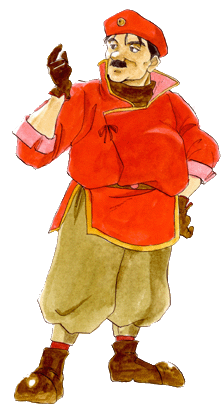
Armed with a new resolve, Odessa wasted no time. She sought like minded individuals, people who also hated the Empire. She found quite a few: soldiers that were dissatisfied with their roles, angry citizens, the works. Some of the most important recruits she had found included Humphrey Mintz, former Imperial captain, who abandoned the Army after the Kalekka Incident. The Kalekka incident was where several Imperial soldiers massacred the people of the town of Kalekka and then blamed it on the invading country of Jowston, to spread a pro war sentiment among the war weary people. Another important recruit was Mose, chief of the Secret Factory, that made new, innovative weapons for Odessa's growing Army.


Pictured: Mose. Brilliant Blacksmith, devoted husband and father, and all around nice guy. His semblance to Hitler is most unfortunate.


From the get go, Odessa planned everything. Whereas most revolutionaries tend to be reactionary, Odessa was a visionary. She knew the day would come where her Liberation Army would be large enough to take on the Empire directly in battle. She knew who she'd face, so she purchased from the neutral Dwarfs of the Great Forest the plans for a brilliant weapon: a type of flamethrower called a Fire Spear. She knew the Liberation Army would need it. She was right.

With a few skirmishes here and there, the name of Odessa spread like a flame among the dissatisfied and angry populace of Scarlet Moon. She went from the being known as Leon Silverberg's niece to a few people, to the biggest dissident in the Scarlet Moon Empire. Her name became known to all, even in the highly remote village of Sarady and the bandits of Mt Tigerwolf.

One day, she met someone. He was the son of Teo McDohl, the Undefeated General of Scarlet Moon. His name was Tir, and it was he who'd eventually inherit Odessa's position. Tir, betrayed by the Empire, was taken in by Odessa, and given the choice by her to join her army. With time, Odessa helped open Tir's eyes to the true nature of the Empire: corrupt, brutal, inhuman.

One day, as Tir and Odessa returned to the Liberation Army's hideout after a mission, only to find that the Empire was attacking. Tir and Odessa enter the hideout, in an attempt to drive off the attackers. Odessa, however, saw something she did not like: a child was in danger. A few imperial soldiers surrounded the child, perhaps with the intention to kill him. With her bow and arrow in hand, she leaped into action, saving the child. However, she was outnumbered, and the soldiers proved to be more than she could handle. She was fatally injured, but the child was saved. Sadly, she was beyond saving. With her last breath, she turned leadership into Tir's hands, her final request being that he not allow the hope offered by the Liberation Army to die. Per her request, her body was thrown into the sewers, never to be discovered. As far as ANYONE was concerned, Odessa was still alive, leading from the shadows.

Odessa formed and led an army of rebels to overthrow a corrupt Empire. She was an icon of the people, a real living legend. She was a woman who walked the walk and talked the talk. She touched the lives of hundreds, and inspired thousands. Her actions helped topple an Empire rotten to the core and replace it with a new, representative Republic. And she was only 25 when she died.

Odessa Silverberg: She's awesome.


Thursday, August 8, 2013

On the fall of the Scarlet Moon Empire- A tale of the death of a nation.

Suikoden 1, one of the greatest Role Playing Games ever, is more than the story of a ragtag bunch of misfits overthrowing a corrupt empire. It's a fable, a warning to all nations, to all heads of states and to all citizens. Here's why.

Suikoden 1 takes place in the Scarlet Moon Empire, a country located in the nameless world of the Suikoden series. It completely surrounds a lake called Toran, a lake so large it is almost an inland sea. The empire is located south of the City-States of Jowston, which is officially an enemy nation; east of an as yet unnamed country, and north of what was once known as Kooluk, a nation which was also hostile towards Scarlet Moon due to border disputes.

Map of the Scarlet Moon Empire, not to scale. 

The Scarlet Moon Empire was founded well over two hundred years before Suikoden 1 takes place, in the year 230 of the in game calendar. Founded by Kranach Rugner, nicknamed the Knight of the Scarlet Moon, this region used to be a part of a much larger nation known as Harmonia, a nation that still exists during the time of Suikoden 1. Seventy years after its founding, the new empire began to have several border disputes with its southern neighbor, the Kooluk Empire. During the time where Scarlet Moon gained the upper hand, many of its nobles would ride unto the villages south of the Scarlet Moon-Kooluk border, where they would engage in what would cruelly be called "Human hunts", a fancy name for pillaging, murdering and probably raping the defenseless Kooluk citizens. These "human hunts", through a turn of events far too extensive to discuss at this moment, eventually led to the dissolution of Kooluk. With Kooluk destroyed, Scarlet Moon found itself facing a new enemy: their northern neighbor, the newly founded City-States of Jowston. To counter the threat, the Empire built a new prison, named Soniere, and a slew of new castles, including Scarleticia and Moravia. With its borders protected, it appeared that no outside force could ever defeat the Empire.

And it was true, no outside threat could topple such a well defended empire. But inner threats can topple any nation, no matter how powerful.

In the year 446, a mere forty years after the completion of Moravia Castle, Scarlet Moon entered a civil war. The emperor, Michelan Rugner, had passed away, and it seemed his son, Barbarossa Rugner, would inherit the throne. However, there was a problem, for Michelan's elder brother, Geil Rugner, wanted the throne for himself after his birthright as the first born was denied by his father. Having convinced, and blackmailed, the nobles of Scarlet Moon, Barbarossa's right to the throne was denied, and Geil himself was crowned. However, Barbarossa knew that it was he, and not his uncle, who was the rightful heir to the throne, and thus he amassed his own forces to reclaim what was rightfully his.

Barbarossa Rugner, last emperor of Scarlet Moon, armed with his trusted sword, Prakk


After many months of fighting, Geil's forces were defeated, and the pretender to the throne was thus executed by the rightful Emperor. But the war was not without sacrifice. Aside from the deaths of soldiers and citizens, the Empress Consort, Claudia, was assassinated by Geil's forces. It was a loss from which Barbarossa would never recover.

Emperor Barbarossa was a kind man, warm and wise, he was nicknamed the Golden Emperor. Under such a man, any kingdom or empire should flourish. But, Barbarossa was a person, first and foremost. And if there is one thing that's certain about people, is that we are flawed, and make mistakes.

A mere months after the civil war ended, the forces of Jowston invaded Scarlet Moon. The people of the empire, tired of war, were not happy that so many resources were being spent on the war effort. Barbarossa asked his supervisors for a way to rid Scarlet Moon of Jowston's armies. The chief strategist, Leon Silverberg, came up with a simple, yet horrifying idea: take the occupied town of Kalekka, drive off the occupying force, massacre the citizens leaving behind no witnesses or survivors, and blame the whole thing on Jowston. It worked, a pro war, anti Jowston sentiment arose across the empire. But, at a price: a great many soldiers, generals, and government officials that had known the truth of the incident defected from the Empire. With such a loss of talent, the Empire began to fill these roles with people that were far from deserving, such as the monstrous and corrupt Kraze Miles, who was made Captain of the Imperial Guard.
Pictured: Kraze Miles. Not Pictured: a decent human being.


Anti Imperial sentiment spread across the Empire like a flame in the night. Perhaps one of the most famous dissidents was a woman named Odessa Silverberg, niece to Leon Silverberg, and leader, as well as possible founder, of the Liberation Army, an armed force dedicated to toppling Imperial rule.

Pictured: Odessa Silverberg, one of the most awesome female characters in video games. Anita Sarkeesian has probably never heard of her.


Unfortunately, Odessa loses her life, sacrificing herself to save the life of a child. (On my next entry, I will discuss why Odessa is one of the best female characters in gaming, even after death.) She passes on leadership of the Liberation Army to Tir McDohl, son of the undefeated Imperial General Teo McDohl, and the main hero of Suikoden 1. Under Tir's leadership, the Liberation Army overthrows Scarlet Moon, to be replaced by a new, more representative government, the Toran Republic.

Tax theft, corruption, brutality, starvation, piracy. These are all problems that had plagued the Scarlet Moon during its waning years. And where was the Emperor during all this? Why didn't he do anything?

Emperor Barbarossa lost all motivation upon the loss of his wife, Claudia. During his ten year reign, he went from being a beloved ruler of the people, to a despot that did nothing as his empire crumbled. His Court Magician, Windy, used her strong semblance to Claudia, and the emperor's love for her, to fulfill her own dark ambitions. The emperor allowed his emotions to cloud him, disconnect him from the empire he had fought so hard for. His hands stained by the blood of innocents, it was the Golden Emperor, a man so loved by the people at first, a man who, when you remove the crown from his head proved time and again to be a good person, who brought down the end of the empire. Barbarossa's rule could have been the start of a Golden Age for Scarlet Moon, but was instead its downfall. But why? Why did it happen?

Because, at the end of the day, Barbarossa was a man. He had his strengths, and he had his weaknesses. But Barbarossa was not given the position of just any man, he was Emperor. He was a ruler, a leader. And when you're a leader, there is no room for flaws, no room for weaknesses. Barbarossa's weakness was that he never got past the death of his wife, Claudia. And therein lays an interesting question. What of the people who died for him? Did he mourn them as he did his wife? Did the people that died for Geil deserved to be mourned as well? Did Geil deserve someone to mourn him as Claudia did? If you will mourn someone who died in war, why not mourn everyone that has died? How many names of the people that died for him did Barbarossa memorize? And what would they say if they found out what they died for? Barbarossa didn't just destroy his empire, he sullied the sacrifices that were made in HIS name. In the end, power was placed in the hands of a weak man, a man who, when it came down to it, had no business being an emperor. The system that placed him in power had fallen into decay, allowing the cruel, the brutal, and the corrupt to assume positions of undue power. And when a system like this fails the people, it is the people themselves who rise up and destroy the system, replacing it with a new, better one.

And this happens in real life. When corruption is law, the lawless become heroes. When rulers show themselves to be inept, the followers look elsewhere for a leader. The governments that try to rule by fear, end up facing a population that is unafraid. Such is the spirit of revolution.

A warning to all governments, to all heads of state: You exist because of the will of the people. When you attempt to bamboozle your citizens, they will rise up and overthrow you. And if you need to use deadly force to quell dissent, then you have already lost. For power comes not from the threat of force, but from the consent of the governed.


Tuesday, August 6, 2013

Player Character Point of View- Romancing Karen in Harvest Moon: Friends of Mineral Town

 My name? Well, people call me Pete. When I was much younger, my folks took me on vacation to this quiet little place called Mineral Town. One day, I got separated from my parents, and ended up on this old man's farm. I stayed there until my parents found me, playing with the animals, enjoying the fresh air. The old man and I struck up a friendship, and we kept exchanging letters. I had no way of knowing that on that day, my future was sealed...

The old man simply stopped writing one day. I grew worried about him when he wouldn't respond my letters, so I went to visit him. I had run into the mayor, who gave me the two biggest shockers of my life. First, the old man died. I nearly fell on the floor when I heard that. My friend died. The mayor then told me that the old man left me the farm.

The old man had no family. He left his farm to a kid that exchanged letters with him for years. I wanted to cry for him.

I had no time to waste. The farm was mine now, and frankly, it was in dire need of repairs. My 'house' was little more than a dusty shack. The barn was empty, just like the chicken coop. The fields were chocked with weeds, stones, and dried up stumps and branches. Impossible to clean up by myself. So, I cleaned up a bit, had myself a small lot for farming, and went to the market to get some seeds. That is when I met...her.


I had never seen a more beautiful girl in my life. When I entered the market, she walked up to me, greeted me and gave me a free bag of grass seeds. I smiled like such a goof! I walked up to the counter, bought a bag of turnip seeds, and walked out of the market, telling her goodbye. My heart was racing that day!

After that, I ran into her every now and again. Sometimes, when I'd take a break from my farm, I'd find her by the waterfall close to Mother's Hill, on the edge of Mineral Town. Whenever I went shopping for supplies, I'd see her working in the store, and I'd tell her hello. She and I would always talk, always happy to see each other. I really liked her. Barley, the man who worked the cow farm, told me that the key to showing how much I liked a girl was to give her something she liked. I eventually learned that Karen really liked wine.

I bought her wine every chance I had. Wine was expensive, and I wouldn't always have the money for it, but I bought it anyway, for her. I still sometimes chuckle at the memory of the time she beat Duke, the local winemaker, in a drinking contest! That was amazing.

She isn't the best cook in the world. She'd always enter the yearly cooking contest, even though she always came dead last. She always tried cooking some weird recipes. One time, she mixed chocolate into a fish stew! I still laugh about how it was so bad it sent me to the clinic, even if at the time I didn't find it so amusing.

I would often walk with her on the beach after sundown. Yeah, most of the time I'd be bone tired, with my body aching quite a bit after farm work. And sometimes I'd do things that were just silly, like walking under the rain for over an hour just so I could visit her at the market, and give her a bottle of wine, or something I had cooked for her in my kitchen. Yeah, I'd often catch colds because of that, miss a few days or work. But you know what? It was always worth it to me, to see her smile.

When my farm became more successful, I had my old shack expanded into a real house, with a few more rooms and a few more amenities. Sure it wasn't a mansion, but it was a good house. Good enough for the family of a farm man.

A family. I had long decided that I loved Karen. I knew in my heart of hearts that I wanted to marry her. I bought the Blue Feather, which is the custom in Mineral Town, to ask her to marry me. She said yes!

We're married now, expecting a child. My life is amazing, and it's all thanks to that one time I got lost. Thank you, old man. I'll name my son after you.

Sunday, August 4, 2013

The Crooked Man: On failed dreams, depression, and hope

The Crooked Man is not the best game ever made. It is not the most sophisticated game, it is not the most graphically impressive game ever made, but it still is one of the best games you will ever play.

(Warning: Spoilers ahead.)

In The Crooked Man, you play as David Hoover. David's a nice guy. He's a decent man, works as a clerk, earns his own money. He also has a mother with a tumor in her brain that's caused her to go senile, his lover abandoned him, and his dream of becoming a pilot is pretty much dead thanks to him being colorblind. To try and get over how much his life has disappointed him, he moves into a shabby apartment that is in need of repairs. During the night, he experiences several paranormal phenomena that inspire him to look for the apartment's previous tenant. Thus begins the story of The Crooked Man.

David's journey first takes him to the Hotel Ruhenheim (Which means Rest home in German), an abandoned hotel that held special significance to the previous tenant. In here he first encounters the eponymous Crooked Man: a vile monster with a crooked neck, an unstoppable force that aims to kill David. In this level, we also learn of David's failed romance with the woman whom he planned on marrying. Because of his meekness, especially compared to her fiery attitude, David's girlfriend, Shirley, abandoned him. During his trek through the hotel, David meets someone in a similar position: a woman named Sissy. Sissy's boyfriend had also previously left her, and she's come to the hotel to search for a memento from her boyfriend. After several events which I shall not spoil, David gives Sissy a speech on what it means to love, to lose, and to keep going.

The game then takes us to Julius Stone Law School. Here, David meets a young man nicknamed D, who has failed the Bar exam a total of five times, and is currently vying for his sixth attempt. Once more, David finds himself menaced by the Crooked Man. David also confronts his failed dream: to become a pilot. I had mentioned earlier that he had been unable to become a pilot, due to his color blindness. David, until this point, remained haunted not just by this failure, but by the efforts he made to overcome his shortcomings and become a pilot regardless. He cheated on his sight test, breezed through his courses, and became top of his class, only to be found out and expelled on the day of his test. D has also gone through something similar. All his life, D dreamed of becoming a lawyer. Unfortunately, once he got into Law School, he learned of his one glaring weakness: He simply didn't have the book smarts to be a lawyer. He tried and tried, he studied like crazy, dedicating every moment he could to hitting the books. He took extra classes, he took tutoring, he asked for direct help from his professors. And what did he achieve? He barely graduated, and has failed the Bar exam a total of five times. He tries and tries, but ultimately keeps failing. It is here that David makes peace with his failure, and encourages D to move past his shattered dream, while subtly encouraging himself to move past his own failure.

The game next takes us towards an abandoned hospital. While here, David meets a boy nicknamed Fluffy, whose mother is missing. During his trek through the hospital, David is confronted with a horrid memory: one night, when his mother's condition took a turn for the worse, her dementia caused her to forget about her son, which caused her in turn to believe that David was a stranger who meant to harm her. In a moment of absolute weakness, David attacked his mother, and would have murdered her if not for his friend, Paul's, sudden intervention. From that day forward, David felt his mother did not love him, that she had abandoned him. Fluffy, during their time exploring the hospital, begins to feel abandoned by his mother as well. David tries encouraging Fluffy, but they are attacked by the Crooked Man. David fails to make peace with his past at first, but he eventually does.

Who is David Hoover? He's a guy with a failed love life, a mediocre job, an unfulfilled lifelong ambition, and a dying mother. He's trapped by his own failings, his own meekness, and his own mediocrity.

He's also one of the kindest, most dependable guy you could ever meet. He goes out of his way to make sure Sissi and D are alright, warning them of the Crooked Man as soon as he can. He goes above and beyond the call of duty to protect Fluffy from this vile monster. He saves D's life at his own risk! He rescues Sissi from death twice! He actually fights off the Crooked Man and pushes him off the roof of a four story hospital to protect Fluffy! David is so immersed in his own sadness, his own sorrow, that he fails to recognize his greatest strengths, attributes, and his blessings. His friends love him, and often go out of their way to make sure he's alright. He has a job that allows him to have his own place. He's kind, an attribute women often find attractive.

That's what depression is like. We become overwhelmed by our own negative feelings. Through our minds there is an echo, repeating a list of our worst flaws. "I'm weak, I'm unworthy, everyone would be happier if I were gone." After a while, sometimes depression goes away, but often, we sink deeper into our own negativity. And we keep torturing ourselves, inching ever closer into the edge of this abyss. And when you finally stare down, that's when it hits you, an idea that a healthy person would find repulsive: suicide.

Ladies and gentlemen, I'd be lying if I said I did not identify with David up to a certain point. Often video games give their heroes some extraordinary reasons to act depressed, extraordinary tragedies that affect their lives. An example would be Ryu from Breath of Fire 1, who lost his village in an attack from the villains of the game. Or Fayt Leingod from Star Ocean 3, who was experimented on as a child to act as a weapon against aliens from another dimension. But David? What happened to him can happen to all of us. Depression? A lover leaving you? A senile parent? A dream that went unfulfilled? That's normal, everyday things that can happen to anybody, and often does. These are real life tragedies that often go ignored by those who do not suffer them. And often, we are told that these things are no big deal. "Oh, your mom is suffering dementia? Somewhere in Africa a woman has died from war, think about THAT while you whine! Oh, you can't get into the college you wanted? Let me play you a song on the world's smallest violin while we think of those starving kids in Asia!" Often people downplay the things that get them down, because we often mock depression. Wangst, we call it. Excessive whining. And that is one of the many, many reasons we often do not seek help when we're depressed.

Depression is a real thing. People kill themselves because they often hit that moment, that Event Horizon of Despair, that sends them spiraling into a vicious circle of feelings of self loathing and entrapment. People kill themselves to escape from this vicious circle. And trust me when I say that the moment you hit that level of sorrow, the moment you see your own death as the ONLY relief from this much sadness, that is one scary moment.

The abyss is dark and seemingly bottomless. We often hold onto something, the ledge, to keep from falling in. But we don't need to fall.

When we're in our darkest hour, we need to find our light. We need to focus on what we are good at, what our best virtues are. Life is tough, that's a given. We fail more often than we win. It is when we are down that we need to find the strength to get back up. Most of the time, we do this by ourselves. But sometimes, the pain is so great, we are unable to get up. We've fallen, and we can no longer get up. That's when we have to find to remind ourselves of who we are. Like David, we need to remember our greatest strengths. For David, it was his kindness. We must also overcome what we feel is our greatest weaknesses. For David, he thought he was meek, a doormat, but he proved to be anything but when he faced down the Crooked Man. And just as important, we need the people who love us. When David had become suicidal, it was Paul who came to his rescue. Paul and his wife Marion drove for a whole day towards a place they had never been to, all to make sure David would be OK. Just like that, we need to learn to trust the people that love us.

In South Africa, there is a philosophy, called Ubuntu, that is defined as thus: "I am who I am because of who we all are." We humans need to take care of each other, to treat each other with kindness. We can not, should not ignore or ridicule another person's sorrow.

This is what The Crooked Man is trying to tell us. Do good for others. Your sorrow is NOT trivial, because you suffer from it. Kindness and empathy are some of the best qualities a person can possess. You are not alone in your suffering. Your dreams may go unfulfilled, but when that happens, find a new dream. Emotions are a good thing, do not think less of yourself for having them. You will, eventually, stop loving the one who hurt you. Keep the people that love you close, do not doubt them. And most importantly: don't kill yourself. You are better than you think you are.