"The ends justify the means." Ever heard that phrase used before? It's the notion that WHAT you do doesn't matter, only that it gets results. It's a call to clear your conscience of the blood on your hands if you've brought peace. But another haunting quote is "nothing ever ends." What good is a peace attained by blood if that peace doesn't last? Is it really worth killing innocents if it'll bring 10 years of peace? What if it doesn't even get you that ten years? This is one of those conundrums presented (albeit subtly) by the game Suikoden 1.
Showing posts with label Suikoden. Show all posts
Showing posts with label Suikoden. Show all posts
Saturday, June 10, 2017

Wednesday, May 25, 2016
Suikoden 6- My Way
Every day it seems like the Suikoden series will never see another numbered entry. That's exceptionally for the fans who have emotionally invested themselves in the series, myself included. And why not? It's a fantastic series, interconnected by themes of war, history, camaraderie, love, and so forth. So, it's up to the fans to decide what Suikoden 6 would be like. Today, I share my take on what Suikoden 6 should have been.
Tuesday, January 26, 2016
The Main Theme of Suikoden 4
The fourth game in the main Suikoden series, Suikoden 4 is often seen by fans of the series as being one of the worst, or at least most disappointing, games in the series. There are many reasons for this, ranging from the gameplay (a paty of 4 when the series ALWAYS allowed for a party of 6, high random encounter rates) to the presentation (only five or 7 towns to visit, depending on how you count certain areas of the game, and only ten or so dungeons), even the story gets some flak. And it's true, the story of Suikoden 4 is very short when compared to the stories of Suikoden 2 or 3. But just because it's short doesn't mean the story has no meat to it. In fact, a close observation even reveals the main theme of the game: leadership.
Saturday, November 8, 2014
Suikoden 2.5
I'm a huge fan of Suikoden. I'm a proud member of the Suikoden Revival Movement, have signed up for both Suikoden Day 2013 and 2014 (didn't participate because of time constraints, however), and have played Suikoden 1, 2, 3, 4, and Tactics. I've yet to play 5 because I have no money, but it's on my bucket list. Anyway, there is a certain, fan made Suikoden game that I've been keeping my eye on for a while now, and I think every Suikoden fan owes it to themselves to do the same. The game is called Suikoden 2.5.
Friday, August 15, 2014
Suikoden Day- Why It's Needed
Suikoden Day, a time of celebration for fans of the video game series Suikoden, where fan works are presented and shared, contests are held, and overall a feeling of brotherhood is felt throughout the fandom. This day, held this year on August 15, 2014, is a day for camaraderie, a day for fans to remind each other that they are not alone, that they belong to an international brotherhood united in a common bond: their love for a grossly underrated series. But, do we really NEED a Suikoden Day?
Saturday, November 23, 2013
An Analysis of Suikoden 3
Although I adore Suikoden, I must admit that the third entry in the series is one that is rather divisive; you either love it or you hate it, and there are strong arguments that justify both positions. However, one thing that is not up to debate is that Suikoden 3 tried something very different from its predecessors, and in large parts succeeded in telling a very memorable story via a very unique Perspective system that allows the player to go through several Point of View characters. But what is Suikoden 3 about? Well, let's find out.

Tuesday, October 15, 2013
The top 11 video game heroes- Number 6
The countdown continues with the sixth entry. I admit, there may be a bit of bias here, because this particular character is one from my youth. I love this character (no homo), he represents, to me, much more than just what a hero should be. He is someone I aspire to be like, someone worth emulating. This character is everything I wish I could be, he is a leader, a fighter, a hero. His name is Tir McDohl, and he hails from that PS1 classic, and one of my all time favorite games, Suikoden 1.

Wednesday, September 11, 2013
An Analysis of Suikoden 2
It's no secret that Suikoden is one of my all time favorite video game series, and that it disappoints me greatly that Konami has all but canceled the series. Still, every now and then it is a good idea to revisit the series. It is in my opinion that every RPG has a main theme, an element that drives the story. Suikoden is no different. And today, I analyze the element that drives the story behind the one entry that is generally regarded to be the best in the series, Suikoden 2.

Available on Ebay for about $130 because Konami can't be arsed to put this title on the PSN Store. Also available for the PSP in Japan because Konami can't be arsed to translate the game and ship it anywhere else.
Friday, August 30, 2013
Character Analysis- Snowe Vingerhut from Suikoden IV
There are plenty of characters in the Suikoden series that players simply adore, like the subject of my previous character analysis, Odessa Silverberg. But, there are also plenty of characters that are just plain hated, for a variety of reasons. Some of them are hated because it takes too much work to recruit them, only for the character him/herself to be mediocre at best. Others are hated because their voice acting is horrid, or their design is uninteresting, or they have zero personality. But today's character is not like that. He's hated for a different reason: his personality. This character is called Snowe Vingerhut.

Look at him. That's some sweet armor he's got there, isn't it? The fact that it didn't come with a helmet is beside the point, as none of the other main characters wear one either. That's plain stupid, but whatever. Acceptable breaks from reality.
We shall begin with a brief description of why Snowe is so hated. He's a rich daddy's boy who has never put in an ounce of work into his life, betrayed his best friend, sold out his country, and worked for the enemy as a pirate hunter while his people suffered. I know what you're thinking, "what an ass". It is little wonder why he's so hated. But, a question: does he deserve the hate? Who is Snowe, really? What makes him tick? That's what we're going to look into today.
Saturday, August 10, 2013
Character Analysis-Odessa Silverberg from Suikoden 1
It has been said by certain online critics whose names shall not be mentioned, that in the video game industry there is a shortage of female characters that are strong, independent, and who embody the ideals of feminism. They say that most female characters in gaming fall into a select few categories, including the much reviled Damsel in Distress. I respectfully, but strongly, disagree. I believe that for every female character that's little more than a plot device, there is another female character that is well rounded, with flaws and strengths. Today, I will look at one of these strong characters, female. Her name is Odessa Silverberg, and she hails from the game Suikoden 1.


This is not Princess Peach.
Born into the nobility of the Scarlet Moon Empire, Odessa spent the early part of her life completely ignorant to the injustices her country were committing against the common populace. One day, she had met a young rural aristocrat named Achilles, who was a member of the Anti Imperial movement. They both fell in love and became engaged to be married. Before the wedding, the Captain of the Imperial Guard, a ruffian named Kraze Miles, arrested Achilles on accounts of treason. Sentenced to death, Achilles asked to marry Odessa, as a final request. On the day of their wedding, Odessa sneaked into Achilles' jail cell, wearing her wedding dress, stole a sword, busted Achilles out of jail and dragged him away while they were both shot by several archers. Though they had managed to escape, Achilles was far too injured. In his final moments, Achilles spoke his last words to his lady love: "Defeat the Empire!". He died in her arms shortly afterward.
Armed with a new resolve, Odessa wasted no time. She sought like minded individuals, people who also hated the Empire. She found quite a few: soldiers that were dissatisfied with their roles, angry citizens, the works. Some of the most important recruits she had found included Humphrey Mintz, former Imperial captain, who abandoned the Army after the Kalekka Incident. The Kalekka incident was where several Imperial soldiers massacred the people of the town of Kalekka and then blamed it on the invading country of Jowston, to spread a pro war sentiment among the war weary people. Another important recruit was Mose, chief of the Secret Factory, that made new, innovative weapons for Odessa's growing Army.
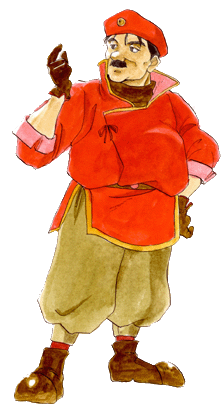
Pictured: Mose. Brilliant Blacksmith, devoted husband and father, and all around nice guy. His semblance to Hitler is most unfortunate.
From the get go, Odessa planned everything. Whereas most revolutionaries tend to be reactionary, Odessa was a visionary. She knew the day would come where her Liberation Army would be large enough to take on the Empire directly in battle. She knew who she'd face, so she purchased from the neutral Dwarfs of the Great Forest the plans for a brilliant weapon: a type of flamethrower called a Fire Spear. She knew the Liberation Army would need it. She was right.
With a few skirmishes here and there, the name of Odessa spread like a flame among the dissatisfied and angry populace of Scarlet Moon. She went from the being known as Leon Silverberg's niece to a few people, to the biggest dissident in the Scarlet Moon Empire. Her name became known to all, even in the highly remote village of Sarady and the bandits of Mt Tigerwolf.
One day, she met someone. He was the son of Teo McDohl, the Undefeated General of Scarlet Moon. His name was Tir, and it was he who'd eventually inherit Odessa's position. Tir, betrayed by the Empire, was taken in by Odessa, and given the choice by her to join her army. With time, Odessa helped open Tir's eyes to the true nature of the Empire: corrupt, brutal, inhuman.
One day, as Tir and Odessa returned to the Liberation Army's hideout after a mission, only to find that the Empire was attacking. Tir and Odessa enter the hideout, in an attempt to drive off the attackers. Odessa, however, saw something she did not like: a child was in danger. A few imperial soldiers surrounded the child, perhaps with the intention to kill him. With her bow and arrow in hand, she leaped into action, saving the child. However, she was outnumbered, and the soldiers proved to be more than she could handle. She was fatally injured, but the child was saved. Sadly, she was beyond saving. With her last breath, she turned leadership into Tir's hands, her final request being that he not allow the hope offered by the Liberation Army to die. Per her request, her body was thrown into the sewers, never to be discovered. As far as ANYONE was concerned, Odessa was still alive, leading from the shadows.
Odessa formed and led an army of rebels to overthrow a corrupt Empire. She was an icon of the people, a real living legend. She was a woman who walked the walk and talked the talk. She touched the lives of hundreds, and inspired thousands. Her actions helped topple an Empire rotten to the core and replace it with a new, representative Republic. And she was only 25 when she died.
Odessa Silverberg: She's awesome.
Thursday, August 8, 2013
On the fall of the Scarlet Moon Empire- A tale of the death of a nation.
Suikoden 1, one of the greatest Role Playing Games ever, is more than the story of a ragtag bunch of misfits overthrowing a corrupt empire. It's a fable, a warning to all nations, to all heads of states and to all citizens. Here's why.
Suikoden 1 takes place in the Scarlet Moon Empire, a country located in the nameless world of the Suikoden series. It completely surrounds a lake called Toran, a lake so large it is almost an inland sea. The empire is located south of the City-States of Jowston, which is officially an enemy nation; east of an as yet unnamed country, and north of what was once known as Kooluk, a nation which was also hostile towards Scarlet Moon due to border disputes.


Suikoden 1 takes place in the Scarlet Moon Empire, a country located in the nameless world of the Suikoden series. It completely surrounds a lake called Toran, a lake so large it is almost an inland sea. The empire is located south of the City-States of Jowston, which is officially an enemy nation; east of an as yet unnamed country, and north of what was once known as Kooluk, a nation which was also hostile towards Scarlet Moon due to border disputes.

Map of the Scarlet Moon Empire, not to scale.
The Scarlet Moon Empire was founded well over two hundred years before Suikoden 1 takes place, in the year 230 of the in game calendar. Founded by Kranach Rugner, nicknamed the Knight of the Scarlet Moon, this region used to be a part of a much larger nation known as Harmonia, a nation that still exists during the time of Suikoden 1. Seventy years after its founding, the new empire began to have several border disputes with its southern neighbor, the Kooluk Empire. During the time where Scarlet Moon gained the upper hand, many of its nobles would ride unto the villages south of the Scarlet Moon-Kooluk border, where they would engage in what would cruelly be called "Human hunts", a fancy name for pillaging, murdering and probably raping the defenseless Kooluk citizens. These "human hunts", through a turn of events far too extensive to discuss at this moment, eventually led to the dissolution of Kooluk. With Kooluk destroyed, Scarlet Moon found itself facing a new enemy: their northern neighbor, the newly founded City-States of Jowston. To counter the threat, the Empire built a new prison, named Soniere, and a slew of new castles, including Scarleticia and Moravia. With its borders protected, it appeared that no outside force could ever defeat the Empire.
And it was true, no outside threat could topple such a well defended empire. But inner threats can topple any nation, no matter how powerful.
In the year 446, a mere forty years after the completion of Moravia Castle, Scarlet Moon entered a civil war. The emperor, Michelan Rugner, had passed away, and it seemed his son, Barbarossa Rugner, would inherit the throne. However, there was a problem, for Michelan's elder brother, Geil Rugner, wanted the throne for himself after his birthright as the first born was denied by his father. Having convinced, and blackmailed, the nobles of Scarlet Moon, Barbarossa's right to the throne was denied, and Geil himself was crowned. However, Barbarossa knew that it was he, and not his uncle, who was the rightful heir to the throne, and thus he amassed his own forces to reclaim what was rightfully his.
Barbarossa Rugner, last emperor of Scarlet Moon, armed with his trusted sword, Prakk
After many months of fighting, Geil's forces were defeated, and the pretender to the throne was thus executed by the rightful Emperor. But the war was not without sacrifice. Aside from the deaths of soldiers and citizens, the Empress Consort, Claudia, was assassinated by Geil's forces. It was a loss from which Barbarossa would never recover.
Emperor Barbarossa was a kind man, warm and wise, he was nicknamed the Golden Emperor. Under such a man, any kingdom or empire should flourish. But, Barbarossa was a person, first and foremost. And if there is one thing that's certain about people, is that we are flawed, and make mistakes.
A mere months after the civil war ended, the forces of Jowston invaded Scarlet Moon. The people of the empire, tired of war, were not happy that so many resources were being spent on the war effort. Barbarossa asked his supervisors for a way to rid Scarlet Moon of Jowston's armies. The chief strategist, Leon Silverberg, came up with a simple, yet horrifying idea: take the occupied town of Kalekka, drive off the occupying force, massacre the citizens leaving behind no witnesses or survivors, and blame the whole thing on Jowston. It worked, a pro war, anti Jowston sentiment arose across the empire. But, at a price: a great many soldiers, generals, and government officials that had known the truth of the incident defected from the Empire. With such a loss of talent, the Empire began to fill these roles with people that were far from deserving, such as the monstrous and corrupt Kraze Miles, who was made Captain of the Imperial Guard.

Pictured: Kraze Miles. Not Pictured: a decent human being.
Anti Imperial sentiment spread across the Empire like a flame in the night. Perhaps one of the most famous dissidents was a woman named Odessa Silverberg, niece to Leon Silverberg, and leader, as well as possible founder, of the Liberation Army, an armed force dedicated to toppling Imperial rule.
Pictured: Odessa Silverberg, one of the most awesome female characters in video games. Anita Sarkeesian has probably never heard of her.
Unfortunately, Odessa loses her life, sacrificing herself to save the life of a child. (On my next entry, I will discuss why Odessa is one of the best female characters in gaming, even after death.) She passes on leadership of the Liberation Army to Tir McDohl, son of the undefeated Imperial General Teo McDohl, and the main hero of Suikoden 1. Under Tir's leadership, the Liberation Army overthrows Scarlet Moon, to be replaced by a new, more representative government, the Toran Republic.
Tax theft, corruption, brutality, starvation, piracy. These are all problems that had plagued the Scarlet Moon during its waning years. And where was the Emperor during all this? Why didn't he do anything?
Emperor Barbarossa lost all motivation upon the loss of his wife, Claudia. During his ten year reign, he went from being a beloved ruler of the people, to a despot that did nothing as his empire crumbled. His Court Magician, Windy, used her strong semblance to Claudia, and the emperor's love for her, to fulfill her own dark ambitions. The emperor allowed his emotions to cloud him, disconnect him from the empire he had fought so hard for. His hands stained by the blood of innocents, it was the Golden Emperor, a man so loved by the people at first, a man who, when you remove the crown from his head proved time and again to be a good person, who brought down the end of the empire. Barbarossa's rule could have been the start of a Golden Age for Scarlet Moon, but was instead its downfall. But why? Why did it happen?
Because, at the end of the day, Barbarossa was a man. He had his strengths, and he had his weaknesses. But Barbarossa was not given the position of just any man, he was Emperor. He was a ruler, a leader. And when you're a leader, there is no room for flaws, no room for weaknesses. Barbarossa's weakness was that he never got past the death of his wife, Claudia. And therein lays an interesting question. What of the people who died for him? Did he mourn them as he did his wife? Did the people that died for Geil deserved to be mourned as well? Did Geil deserve someone to mourn him as Claudia did? If you will mourn someone who died in war, why not mourn everyone that has died? How many names of the people that died for him did Barbarossa memorize? And what would they say if they found out what they died for? Barbarossa didn't just destroy his empire, he sullied the sacrifices that were made in HIS name. In the end, power was placed in the hands of a weak man, a man who, when it came down to it, had no business being an emperor. The system that placed him in power had fallen into decay, allowing the cruel, the brutal, and the corrupt to assume positions of undue power. And when a system like this fails the people, it is the people themselves who rise up and destroy the system, replacing it with a new, better one.
And this happens in real life. When corruption is law, the lawless become heroes. When rulers show themselves to be inept, the followers look elsewhere for a leader. The governments that try to rule by fear, end up facing a population that is unafraid. Such is the spirit of revolution.
A warning to all governments, to all heads of state: You exist because of the will of the people. When you attempt to bamboozle your citizens, they will rise up and overthrow you. And if you need to use deadly force to quell dissent, then you have already lost. For power comes not from the threat of force, but from the consent of the governed.
Subscribe to:
Posts (Atom)